Category Archives: celebrity chefs

Fay’s pavlova and the Real food festival

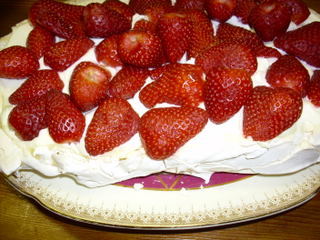
Fay\'s pavlova

Fay’s pavlova is legendary. How does she get the meringue so light on the inside yet crispy on the outside?

Piled high with strawberries (out-of-season but hey, only g-d is perfect), imbedded in whipped organic double cream, the delectable concoction is hard to resist.

Fay and I both rely on the late Evelyn Rose’s recipe for a perfect pavlova. It’s worth buying her book just for that, although (I promise), you will find a ton of other indispensable recipes there too.

Whip four egg whites to stiff peaks, then fold in double the amounts of caster sugar (that makes eight ounces. Sorry, I am so unmetric when it comes to cooking although I am trying, I really am). Fay uses half of white caster sugar and the other half golden caster sugar.

The secret Evelyn Rose ingredient is one teaspoon of vinegar (plus one teaspoon of vanilla). The vinegar seems to ensure that crispy outside and unsticky inside although I am not sure how it works scientifically.

Then spread the mixture on a greased baking sheet and bake in a low oven for two hours.

Being such a purist, my mum (for that is who Fay is) is no freezer-cook but she does (to my surprise) freeze egg whites.

I want to take my mum to the Real food festival on Thursday 24 April as she so appreciates fine raw ingredients.

“You can’t make a silk purse out of a sow’s ear,” she says. You have to buy the best (be it organic, free-range, fresh, seasonal, local and/or artisan) to make a good meal, she says.

If the ingredients are good, no need for complicated recipes (as her mother said before her).

Ingredients, ingredients, ingredients. The only three words you need to know when it comes to cooking.
Real food festival – what a buzz

Fay\'s borscht

As you can imagine, as soon as I got wind of the Real food festival, I knew I had to go.

Opening this Thursday 24 April at 10 am in Earl’s Court, this is London’s foodie festival of the year.

With about 500 small producers under one roof, including Blur musician and cheese maker Alex James, it must be one of the the biggest farmers’ market in the world.

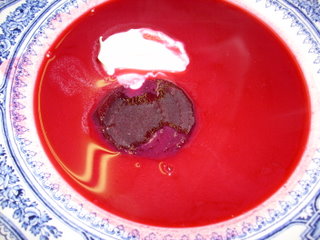
(Thus meriting a picture of my esteemed mother’s borscht. She strains the cooked beetroots, adds lemon juice to the liquid and beats in an egg. See pic from Saturday lunchtime, above.)

The Real food festival ends at 6 pm on Sunday 27 April. Here’s how to get tickets.

There’s a real buzz going on in the food world about this festival. Everyone I speak to is on their way.

I will be going on Thursday. My first stop, Nichola Fletcher’s stall (P648).

Nichola is a deer farmer from Auchtermuchty, Scotland. I just read on her website how the deer in her care are slaughtered. Sentient beings, they die instantly with no stress – it is awesome.

Deer are well-real because they have not been so intensively-farmed or bred (unlike those poor chickens).

Nichola is also an award-winning author. I know Nichola from the Guild of Food Writers. Fellow members, we have ‘met’ online.

I am looking forward to meeting Nichola in real (my favourite word again!) life.

And tasting her compassionately-killed venison.

Fish from Widemouth Bay

Fish soup with fish from Widemouth Bay

On Sunday I crossed counties from Devon to Cornwall. My mission: to buy fish. On a Sunday.

As I drove westward, on my right was the grey/green Atlantic ocean. But I knew its proximity did not guarantee I could buy fish landed from its waters.

We have lost the art of buying fresh fish caught locally. Most fish nowadays is sold in supermarkets. Much comes from far away and has probably been frozen.

This is the tragedy of (so-called) developed countries. The only thing which has developed is mass industrialisation. Thus fishmongers are in danger of becoming an extinct species, swallowed up in the jaws of the supermarket.

But not in Widemouth Bay. Perched above its windswept beach is Beach House Wet Fish , probably one of the best wet fish shops around. And it’s open on a Sunday (until 5.30pm).

The lovely fish lady was apologetic the local boats were not out yet this year. So, my fish came from Looe, a bit further down the coast.

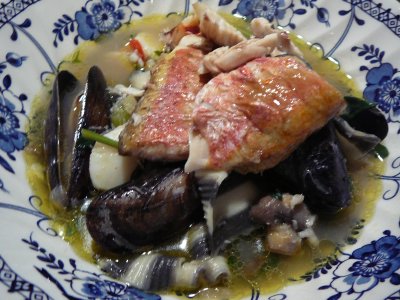
All the fish and shellfish in the bowl (pic above) was bought at Widemouth Bay: the scallops, the mussels, the little red mullets perched atop (which I roasted quickly in a hot oven and added with the fried scallops right at the end of the mussels cooking in the water flavoured with a fillet of ling, fried onion and fennel, and fresh parsley and tarragon).

Here is more detail on an earlier fish soup.

The black and white bits in the above pic are actually pasta, farfalle zebra, coloured with black squid juice (the packet has not been opened for a year but this soup was the right occasion).

I am only sorry I had to drive to get there and back (one hour and a half in total) because I consider cars to be cold mean death machines that are bad for the planet as well as my soul.

Two soups – beetroot and pea

Two soups, pea and beetroot

This two-soup soup was unplanned, a happy result of making pea soup one day, and beetroot soup the next.

Full of fibre and nutrients, it has (unusual for me) no oil or butter. Here is how I did it, food fans.

First, the pea soup. I took 200g of dried split organic peas and covered them with twice their volume with water. Then I added an onion pierced with a few cloves (thank you, queen of vegetarian cooking, Rose Elliot).

Then I cooked it for 40 minutes with a level teaspoon of untreated rock salt. And that’s it! I did not even need to blend because the obedient peas went mushy all by themselves.

As for the beetroot soup, I peeled two of the violent purple things and cut them into cubes (be careful of staining!). Thinks: as the beetroot were organic, did I need to peel? Must experiment with unpeeled next time as do not wish to shortchange myself of extra vitamins oft found in the skin.

Then I added a handful of split red lentils to thicken the soup in an innocuous way. Water to cover (about two mugsful). Plus one level teaspoon of rock salt (Do see the comments here where medical herbalist Elena Renier and I talk salt).

Still on the subject of salt: who needs a silly stock cube? Its main taste comes from salt. So why not bypass the unecessary cube – with all its weird additives – and just add a level teaspoon of sea salt instead?

The lentils and beetroot took half-an-hour to become tender to my teeth. I gave them a helping hand with my power tool, the hand-held blender. This is one kitchen device I would not be without.

Thank you, universe, for letting me have easy access to electricity, unlike the global majority. I am sure there is enough to go round if we could share resources more equally. More fairness please!

Birthday lunch at Bordeaux Quay

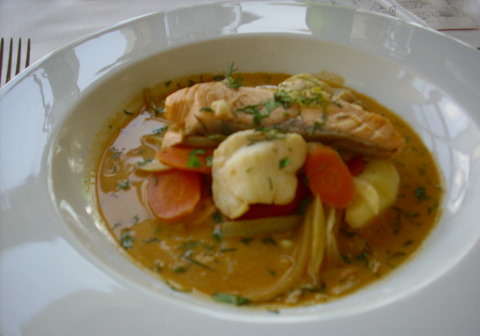
Bowl of fish soup, elegant and simple

My mother’s birthday so we booked a table at Bordeaux Quay. Downstairs is the buzzy brasserie for everyday (good honest dishes), but on this special occasion, we swept upstairs in a lordly way to the restaurant, overlooking Bristol’s waterfront.

We ate so well, and relaxed too. I started with Salade Paysanne, a tumble of leaves with tempting pieces of chicken and duck livers and crispy bacon (perhaps I do eat pork, after all). I ceased eating chicken livers in the 1980s when I realised most were polluted by toxins. Today was different because I could trust the meat came from happy and naturally-fed poultry.

Bordeaux Quay is not merely nodding at sustainable sourcing – its chef proprietor Barny Haughton is the real thing. He has been cooking with organic ingredients (first at Rocinantes, which then morphed into Quartier Vert) for over twenty years – and not even telling his diners because organic was considered too hippy at the time…

You can hear my interview with Barny here where I got to quiz him about his provenance. Barny’s family are organic dudes too, what with his brother, Phil (Better Food) and Liz (The Folk House). Yes, we are well served in Bristol thanks to the Haughtons – god bless their parents for producing such sustainably-minded offspring.

Like Barny, I received my food education at my mother’s knee for which I am eternally grateful.

Next I had cotriade (see pic), a fish stew from Brittany. The (organic) salmon and (line-caught) cod were steamed separately, and added to this dream of a cream crab sauce with sliced earthy carrots and aromatic tarragon and fennel.

My mother – who is the empress of Real Food Lovers – said the meal restored her faith in humankind. Look, when it comes to food, it is no mean feat to please my mother. I hope Barny realises this.

“It’s such a relief to know the ingredients are well-sourced,” I said.

“And you can tell,” said my sister, Geraldine. “It’s all so naturally flavoursome – not just a big plate of nothing.”

Geraldine had masterfully chosen the most marvellous wine, the 2004 Riesling, les Princes Abbés, from Domaines Schlumberger, that even had my daughter Maude raving about its “delicate” flavour.

My mother spoke of her grandmother (another foodie) who left her village, Slonim, in Bellarusse (a hop and a skip from Vilnius) in Czarist Russia, for the east end of London.

“You said she was a revolutionary?” I asked hopefully.

“Nonsense,” said my mum (pic below). “She became very observant and spiritual as she got older but, well, as a girl, she was an atheist and went to secret socialist meetings in Russia.”

“Ha,” I said triumphantly. “And you wonder how we all turned out Bolshie.”

The blog author’s mama at 80-ish, with red hair and stylish floppy hat

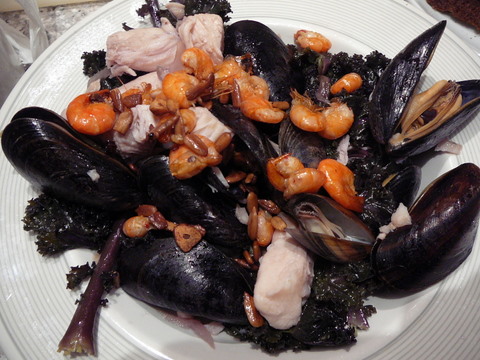
Fish soup with mussels and chilli prawns

Fish soup in a bowl with mussels sticking out and tiny prawns

I am an ungrateful girlfriend. Here was Mike slaving at the stove and here was me finding fault: the kale was too big, and (listen to this bitterness) he never praised my cooking as much as he did his own.

He was raving about this dish (above) and I was jealous. He reassured me that a) he saw it as ‘our’ dish (especially as I had sourced the ingredients) and b) he was particularly chuffed because in the past this would have taken him all day to cook, what with making a fish stock from the bones.

And we (I feel I can say ‘we’ now) had rustled it up in half-an-hour.

Let me recap. One onion fried in olive oil, plus half a mug of water. Added snippets of smoked haddock for salty taste, and monkfish cheeks, in chunks. Then the purple kale.

I was detailed to remove the shells from the shrimps (but not obsessively – I was amazed by what Mike said I could leave on, and the remaining shells cooked up well-crispy). I fried the little creatures in a pan (see below) with sliced dried chili and two sliced cloves of garlic in olive oil.

I reflected how cooking makes the raw and free fall under our dominion. What power.

Mike added the scrubbed mussels (shells tightly closed) to the fish soup and kale.

Nigel Slater, who inspired this dish, says the mussels add more flavour at this point than the rest of the fish put together. I agree.

The shrimps fried with chili and garlic added another layer of gutsiness with the shells’ crispy crunchiness adding a spicy ‘wow’ to the final bowl (See top pic – the broth must have lingered at the bottom of the bowl because not visible in pic but most definitely there).

To Mike, Nigel, the mussels, shrimps, haddock and monkfish, a big thank you for one of the tastiest finger-slurping fish soup experiences of my existence.

Shrimps frying in pan

Help with mussels

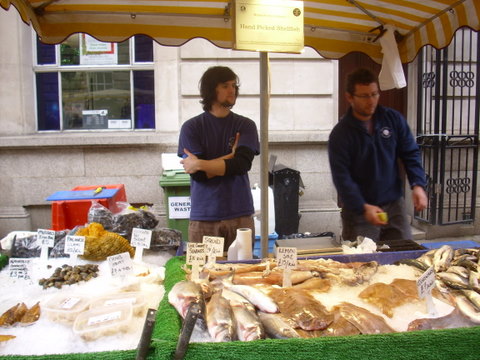
Shellfish stall at farmers’ market

I felt at sea (pardon pun) with the mussels, purchased earlier that day from the Handpicked Shellfish Company at Bristol farmers’ market (see pic, taken a few weeks ago).

10pm on Wednesday and we had not eaten supper. Luckily Mike took over. He was brought up by the sea so knows his fish.

He scrubbed the kilo of mussels (sounds a lot but their shells are heavy) under the tap with a brush, taking off any grey crusty barnacles.

Preparing fresh mussels is hardcore. They are (hopefully) alive when you buy them because a dead one is not fresh and could give you food poisoning. Scary.

When a mussel is dead, its tightly-closed shell opens. So, if when cleaning them, you find one open, you must chuck it. Mike only had to throw one away, which out of a whole kilo, is a testament of freshness.

Top recap. If it is open (before cooking), the mussel could poison you. Bad.

However, when you cook the mussels, the hot steam of your bubbling broth kills them. So the shells open. That’s Good. (Means the mussels are ready to eat).

Listen up, this is complex. If mussel’s shell remains tightly-closed, after cooking, that’s Bad. Means the mussel was unfresh before you started. Throw it away.

(I begun to see why the elders back in the desert said no to mussels.)

I wanted to sweat tinned anchovies (rinsed of the oil they were stored in) just like Nigel Slater told me about last Sunday. But I had none, so I fried an onion in olive oil instead and added half a mug water, slowly.

We now had a bit of bouillon going. Mike popped in some smoked haddock for salty flavouring and the monkfish cheeks, cut in chunky pieces. A firm fish, it keep that firmness when simmered in a stew or soup.

Then Mike added the organic purple kale from Better Food. At this moment I felt the pang of my lesser status, as commis to his chef. Could we not cut up the kale up a bit? I asked, looking with dismay at the large leaves in the pan.

The trouble with accepting help is you lose control. I had lost the right to muscle in on the mussels.

The Delia effect

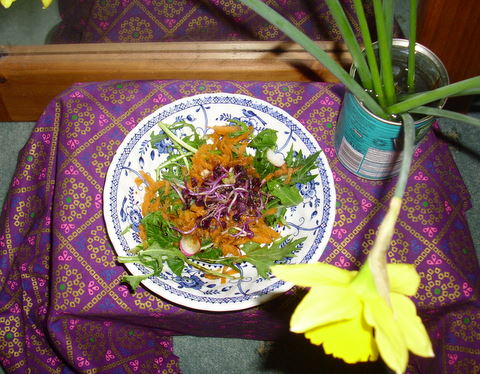
Small bowl of salad (green leaves, carrots and purple radish sprouts)

When Delia spoke to the masses and decreed the poor can eat battery-farmed chickens, did their sales rise?

The “Delia effect” describes the unprecedented sale of certain ingredients after being recommended by TV cook Delia Smith. Her influence is so vast that “Delia” has entered the dictionary.

I am pleased to report that sales for free-range poultry have soared.

This follows the high-profile campaign on TV’s Channel 4 by two other famous cooks, Hugh Fearnley-Whittingstall and Jamie Oliver. They called for higher standards of chicken welfare for all concerned, chickens and their eaters alike.

Sales of free-range poultry rose by 35 per cent in January (compared with January 2007) while sales of standard indoor birds fell by 7 per cent, according to market research company TNS. In response, Tesco doubled its order for higher-welfare chickens.

I mentioned what Delia said to my hairdresser.

Sharp intake of breath. “How can it ever be alright to eat a battery-farmed chicken?” she said.

Listen, she is an apprentice hairdresser so it was gratifying to hear being short of cash does not mean skimping on food quality.

Of course, you have to be a bit canny and cook from scratch. But that’s how most people in the world eat, and why so-called peasant food (such as pasta dishes, stews, curries) tastes so good.

Today’s picture is of a salad made by Chloe, with organic leaves, grated carrots and sprouting radish, that accompanied brown rice and lentils with fried onions, mushrooms and egg, that her dad Mike made. (PS the vase may be corporate but the beans were organic).

This princely meal that cost us about £1.50 each. I rest my case.

Couscous cousins

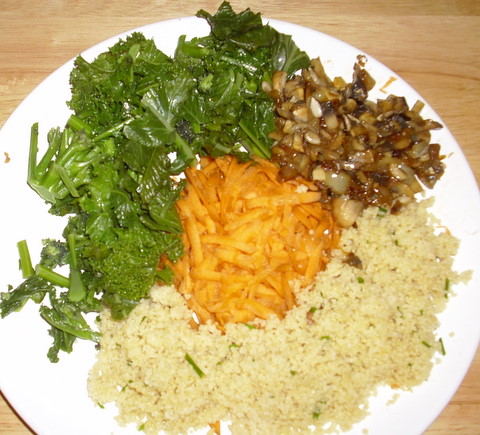
Plate with grated carrots, greens and couscous

Why do people eat pot noodles when there is couscous is in the world? Listen, all you do is pour boiling water over the grains (processed to a teeny size), let five minutes go by while they plump up with water, add olive oil and lo, instant food.

My current top favourite couscous is made from kamut (by Probios) which is good news for all you wheat-sensitive types.

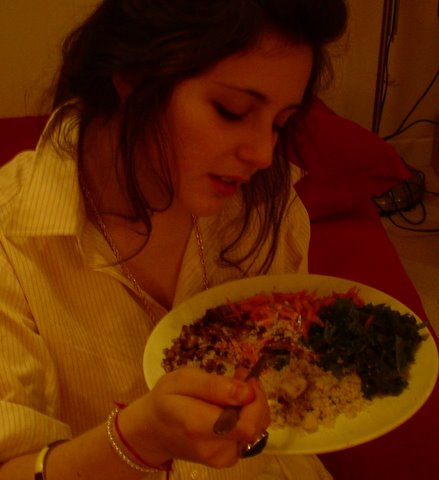
Tonight I added to the couscous, chives (one of the few herbs I can grow as I have pink fingers). I fried onions, mushrooms and chilli, then grated raw carrots (organic of course) and served them with steamed kale and purple sprouting broccoli (cut up quite small).

I made one meal stretch for two unexpected guests, Sarah, my middle daughter, and Juliette, my eldest niece. Juliette, just turned 18, explained how traumatic it was. However she immediately noticed the benefits of being grown up.

How? quizzed Sarah, my daughter the social anthropologist.

Juliette said: “Like. Oh. My. God. I suddenly stopped listening to my story tapes.”

Juliette (pictured) jujudsc10013.jpgwas also disappointed with Delia. “People who are interested in food are just not going to buy Delia. She seems really old fashioned now,” she said.

My mum – the original real food lover empress – is also incensed with Delia for recommending convenience foods while so-called championing the poor. My mother’s letter begins: “Bleeding heart Delia has not done her sums right.”

My mother’s family, immigrants from Russia, lived in the East End of London. They had little on the table and very rarely meat. But they ate well because they knew about food.

Reader, such is my provenance.

Disappointed in Delia

I am still feeling disappointed in Delia.

Claiming to eschew the “politics of food”, she makes this sweeping political statement:

“If the whole world goes organic then the state of the Third World will really be twice as bad as it is at the moment and I’m much more interested in people getting enough to eat.”

Get your facts right, Delia. (And spare me the sanctimony).

Farming organically actually improves the food security of poor countries. It also means farmers in the two-thirds world are not reliant on agrochemicals – which are bad for their health and purse and environment.

The only ‘Delia effect’ I am getting right now is intense irritation at her misinformation.