
My children are carnivores so when they (now grown-up) visit, meat is a treat.
Cheaply produced meat means people can eat it every day as a cheap takeaway.
But eating meat daily is neither good for the health of the animals, consumers or planet.
Some people need to eat meat, while others argue our soils need manure for soil-strength.
We just don’t need to be mass-producing meat on an industrial scale.
So it’s about trying to get a balance. There’s a spontaneous revival of the traditional way of eating: have a feast of (well-reared) meat once a week and live on the leftovers.
Join the Feastarians, Weekend Carnivore or Paul McCartney on a Meat-free Monday.
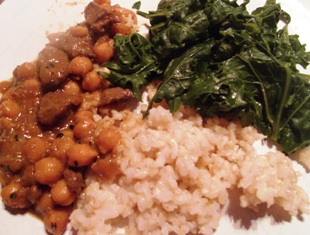
Which leads me to this delicious lamb curry.
Quadrille Books had offered – on Twitter – a free copy of Anjum’s New Indian.
Canny New Media marketing device, eh? I like – and copied it for my own books!
So I contacted Quadrille on Twitter and the big beautiful hardback copy signed-by-Anjum arrived by post.
Its subtitle is Indian Food Made Easy.
Sadly, not easy enough for me. The ingredients list looked too long. The pages too big and glossy.
I felt daunted.
For simplified Indian dishes, I rate Quick Indian Cooking.
However after months of free-book-on-Twitter-guilt, I finally tackled a recipe.
Gujarati lamb and dumpling stew – it was bloody delicious.
But I did simplify it. I left out the dumplings for a start.
Note: I substituted raw ginger for horseradish because Middle Child cannot stand ginger and takes it Very Personally if I cook with it.
Horseradish works incredibly well. Grate it raw, cover with white wine vinegar and it keeps in a jar in the fridge for 3-4 weeks.
Here’s my version:
Ask the butcher for lamb for stewing – or mutton. Mutton is cheaper because it is a grown-up animal. Stewing will soften the tough older meat of mutton.
Unlike pigs and poultry, it is harder to farm sheep intensively – sheep continue to roam freely and eat grass. So if you are going to eat non-organic meat, lamb is your best bet.
I bought about 400g of organic lamb (about £4) which fed 4. I cut up the pieces quite small.
Then I browned the lamb pieces in a pan to seal the taste, then removed them.
Add a teaspoon of mustard seeds and when they pop, add the sliced onions and fry until brown.
My gratitude to Anjum grew – I don’t know what to do with mustard seeds and now I was using them like a pro.
Meanwhile, in a blender (I used the grinder attachment), make a paste of 20g of ginger – or raw grated horseradish – and 5 large peeled garlic.
This paste is a great discovery. I use it for spicy vegetarian dishes too.
Add the paste to the onions until it gently colours, about 3 minutes. Add salt to taste (I omitted the 1 tsp. of sugar), 1 Tbs of ground coriander and 1 Tbs of ground cumin; 1/2 tsp of turmeric and 1/2 tsp of chilli powder. Cook for 20 seconds.
Add about 100 ml water (I omitted the 3 pureed tomatoes) and cook gently until completely reduced, then fry the paste for 5 mins until the oil comes out.
These instructions were brill as I tend to overcook spices and not get the ratio of water-to-spices right (too watery or too dry). This worked! Thanks, Anjum.
I added a quarter of a block of coconut, not the recipe’s can of coconut milk. I also forgot the 1-2 tsp of lemon juice. I didn’t measure the water but Anjum said 200ml (for 600g of lamb).
I forgot the sweet potato but that would have been a wonderful addition.
I chose this recipe because of the chickpeas. I can’t eat a lot of meat – although I do love its rich gravy flavours – so I was happy to have meat-bits with my beloved chickpeas.
I had already soaked 200g of the raw chickpeas overnight and cooked them for an hour (or, as Anjum says, use a can).
I served it with organic curly kale and brown rice.
And it went down a treat with the carnivores.

![Reblog this post [with Zemanta]](https://i0.wp.com/img.zemanta.com/reblog_b.png)


 Real Food Lover